
Electric Vehicle Fire Suppression Systems Australia
Electric vehicles introduce a different fire challenge from conventional internal-combustion vehicles.
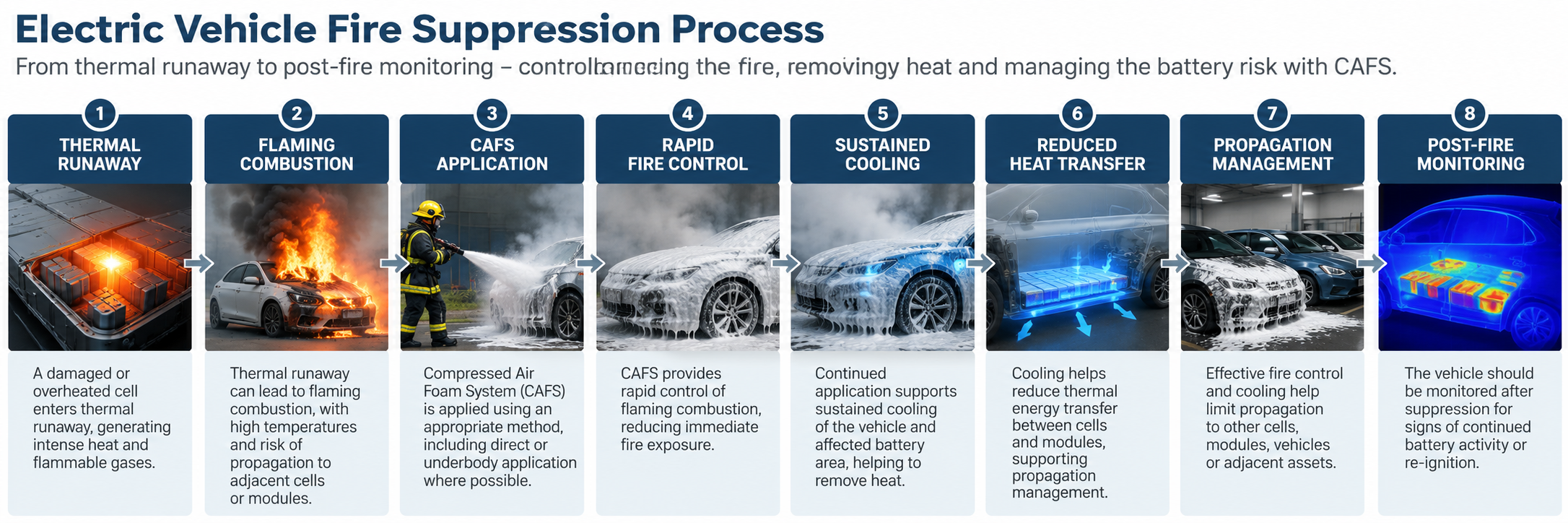
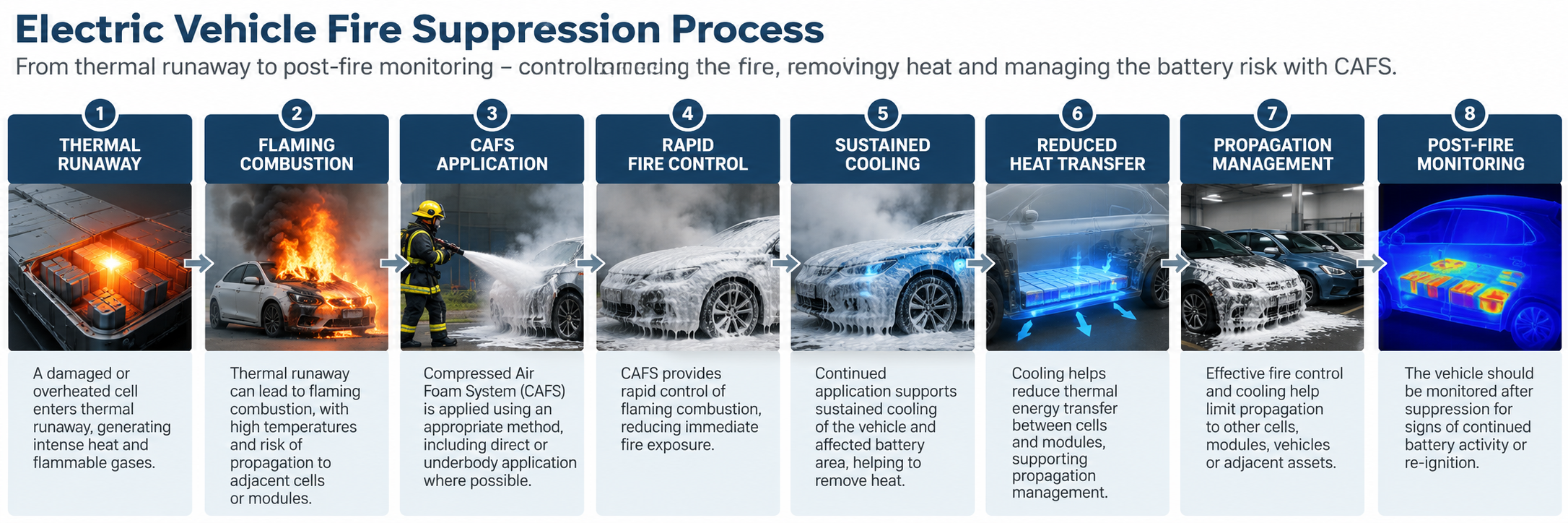
A lithium-ion traction battery can experience thermal runaway, generating intense heat, flammable gases and fire. Heat from an affected cell or module can expose neighbouring cells to sufficient thermal energy to initiate further failures, while the battery pack's location beneath or within the vehicle can make direct firefighting access difficult.
RML AU provides Compressed Air Foam System (CAFS) solutions for electric vehicle fire applications, focused on rapid fire control, sustained cooling, heat removal and limiting thermal energy transfer while using firefighting water efficiently.
Understanding EV Battery Fires
An EV battery pack contains many individual cells assembled into modules and packs.
If a cell is damaged, overheated or experiences an internal failure, it may enter thermal runaway—a self-heating reaction capable of producing high temperatures, flammable gases and fire.
The resulting heat can affect neighbouring cells and potentially lead to further thermal runaway and propagation within the battery pack.
For this reason, extinguishing visible flames around an EV does not necessarily mean the battery hazard has ended.
An effective response needs to consider:
flaming combustion;
battery temperature;
heat transfer between cells and modules;
access to the battery pack;
propagation;
re-ignition;
firefighting-water demand; and
post-fire monitoring.
The Challenge of Reaching the Battery
One of the principal challenges with an EV fire is the location and construction of the traction battery.
Battery packs are commonly installed beneath the passenger compartment and protected by structural enclosures designed for normal vehicle operation and crash protection.
Those same characteristics can make it difficult for an externally applied suppression medium to reach the cells experiencing thermal runaway.
Battery enclosure design can make direct access to cells difficult. As an incident develops, venting, component failure and damage to the battery enclosure may create pathways through which suppression and cooling media can reach affected areas. The effectiveness of any application method depends on the battery design, fire conditions and the ability to deliver cooling to the areas where heat is being generated.
RML AU CAFS for Electric Vehicles
RML AU CAFS combines water, a selected foam concentrate and compressed air to produce an aerated suppression medium designed to provide rapid flame control, coverage and sustained cooling.
For EV fire applications, the objectives can include:
rapid control of flaming combustion;
cooling the vehicle and affected battery area;
reducing heat transfer;
limiting exposure to adjacent components or vehicles;
supporting propagation management;
maintaining cooling following flame knockdown; and
achieving effective intervention with reduced water demand in defined tested configurations.
CAFS cannot be assumed to prevent an initiating battery cell from entering thermal runaway.
The objective is to control the resulting fire, remove heat and reduce thermal energy transfer, helping limit further escalation or propagation.
Explore How Compressed Air Foam Systems Work →
Suppression and Cooling
For lithium-ion battery incidents, flame suppression and cooling need to be considered together.
Rapidly controlling flaming combustion can reduce the immediate fire exposure, but residual heat and continuing electrochemical reactions within the battery can remain.
Sustained cooling is therefore an important component of the response.
RML AU's approach can be summarised as:
FIRE CONTROL → BATTERY COOLING → HEAT REMOVAL → REDUCED THERMAL ENERGY TRANSFER → PROPAGATION MANAGEMENT
The appropriate application technique depends on the vehicle, battery configuration, fire condition and operational environment.
Cooling and Re-Ignition Management
Visible flame extinguishment does not necessarily indicate that the lithium-ion battery has reached a stable condition.
Residual heat or continuing reactions can result in further thermal runaway or re-ignition.
An EV fire response should therefore consider:
continued cooling;
temperature monitoring;
signs of continuing battery activity;
safe vehicle handling and recovery;
post-fire observation; and
the possibility of delayed re-ignition.
The required monitoring period should be determined according to the incident, battery condition and applicable emergency-response procedures.
Reducing Firefighting-Water Demand
Water is an effective and important medium for cooling lithium-ion batteries.
The challenge can be the quantity required to establish and maintain cooling when access to the affected cells is difficult.
RML AU/EZCAFS testing has demonstrated substantially reduced water consumption under defined EV and lithium-ion battery test conditions.
These results should not be interpreted as a universal reduction applicable to every electric vehicle fire.
Actual water demand depends on factors including:
battery chemistry;
battery capacity;
state of charge;
pack construction;
fire condition;
accessibility;
application method;
suppression flow;
cooling duration; and
post-fire conditions.
The objective is not to remove water from EV firefighting.
It is to use water efficiently to control the fire and remove heat.
Firewater Runoff
Firefighting water applied to a burning vehicle may become contaminated by combustion products and materials released during the incident.
Large quantities of water can consequently create additional challenges involving drainage, containment and potentially contaminated runoff.
Reducing the volume of water required for effective fire control and cooling can reduce the volume of potentially contaminated firewater requiring management.
This does not eliminate the need for appropriate environmental or runoff controls.
RML AU / EZCAFS EV Testing
RML AU's EV fire proposition is supported by defined lithium-ion battery testing rather than suppression-agent claims alone.
Testing involving an EV lithium-ion battery pack has examined flame control, battery cooling, water consumption and post-suppression behaviour under specified test conditions.
The test configuration included a 42.7 kWh lithium-ion vehicle battery pack at 100% state of charge.
Following a defined fire initiation and pre-burn period, CAFS was applied to assess its ability to control flaming combustion and cool the battery system.
The test recorded:
42.7 kWh battery capacity;
100% state of charge;
7-minute pre-burn period;
rapid control of flaming combustion;
continued suppression and cooling;
approximately 400 litres of water used during the defined test;
no observed re-ignition during the documented post-test observation period.
These results relate specifically to the tested battery, configuration, fire initiation, application method and test conditions.
They should not be interpreted as demonstrating identical performance for every EV, battery chemistry, pack configuration or fire scenario.
RML AU can provide available technical documentation for engineering review. EZ-CAFS - YouTube
Direct Application Testing
Additional RML AU/EZCAFS testing has examined targeted application methods intended to improve suppression and cooling around the battery area.
Defined tests have included direct application and underbody approaches using comparatively low water-flow rates.
These tests provide useful engineering information about how application method, rather than water quantity alone, can influence fire control and cooling.
Detailed test conditions should always be considered when evaluating the relevance of results to a particular vehicle or application.
Where EV Fire Protection Matters
Electric vehicle fire risk extends beyond roadside incidents.
RML AU works with stakeholders considering EV fire protection in environments including:
vehicle fleets;
fleet charging facilities;
transport depots;
workshops;
car dealerships;
parking facilities;
charging infrastructure;
industrial sites;
ports and logistics facilities; and
emergency-response operations.
EVs located inside buildings introduce additional issues involving confined spaces, smoke, toxic gases, neighbouring vehicles, structural exposure and firefighter access.
These issues are addressed separately in RML AU's Underground Car Park & EV Charging Fire Protection guidance.
Testing and Evidence Before Claims
EV fire suppression performance should be assessed against the conditions under which a system has actually been tested.
Relevant information can include:
battery chemistry;
battery capacity;
state of charge;
pack configuration;
fire initiation;
pre-burn period;
application method;
suppression flow;
application duration;
temperature response;
propagation observations;
total water consumption;
post-suppression monitoring; and
re-ignition observations.
RML AU believes these details are more meaningful than a headline claim that a system simply “extinguishes lithium-ion battery fires.”
A Different Approach to EV Fire Suppression
For an electric vehicle fire, the question should not simply be:
“How quickly can we extinguish the visible flame?”
The response should also consider:
Can the battery area be effectively reached?
How quickly can flaming combustion be controlled?
How effectively can heat be removed?
Can thermal energy transfer and propagation be limited?
How much firefighting water is required?
How will potentially contaminated runoff be managed?
How will the vehicle be monitored after suppression?
What test evidence supports the proposed approach?
These questions should form part of an evidence-based EV fire response strategy.
Discuss Your EV Fire Protection Requirements
RML AU works with fleet operators, facility owners, engineers, emergency-response organisations and other stakeholders to assess CAFS applications for electric vehicle and lithium-ion battery fire risks.
Control the fire. Remove the heat. Manage the battery risk. Use water efficiently.
Talk to RML AU about your EV fire protection requirements.