BESS Fire Suppression Systems Australia
Battery Energy Storage Systems (BESS) are becoming critical infrastructure in Australia's transition to renewable energy. As installations increase in capacity and quantity fire protection strategies must address the particular hazards associated with lithium-ion batteries. Including thermal runaway, fire propagation, flammable and toxic gases, re-ignition, prolonged cooling and potentially significant firefighting water requirements and associated environmental risks.
RML AU provides engineered Compressed Air Foam System (CAFS) solutions for BESS applications, focused on rapid fire control, sustained cooling, limiting thermal energy transfer and reducing firefighting-water demand.
Understanding Thermal Runaway
Lithium-ion battery fires present different challenges from many conventional fires.
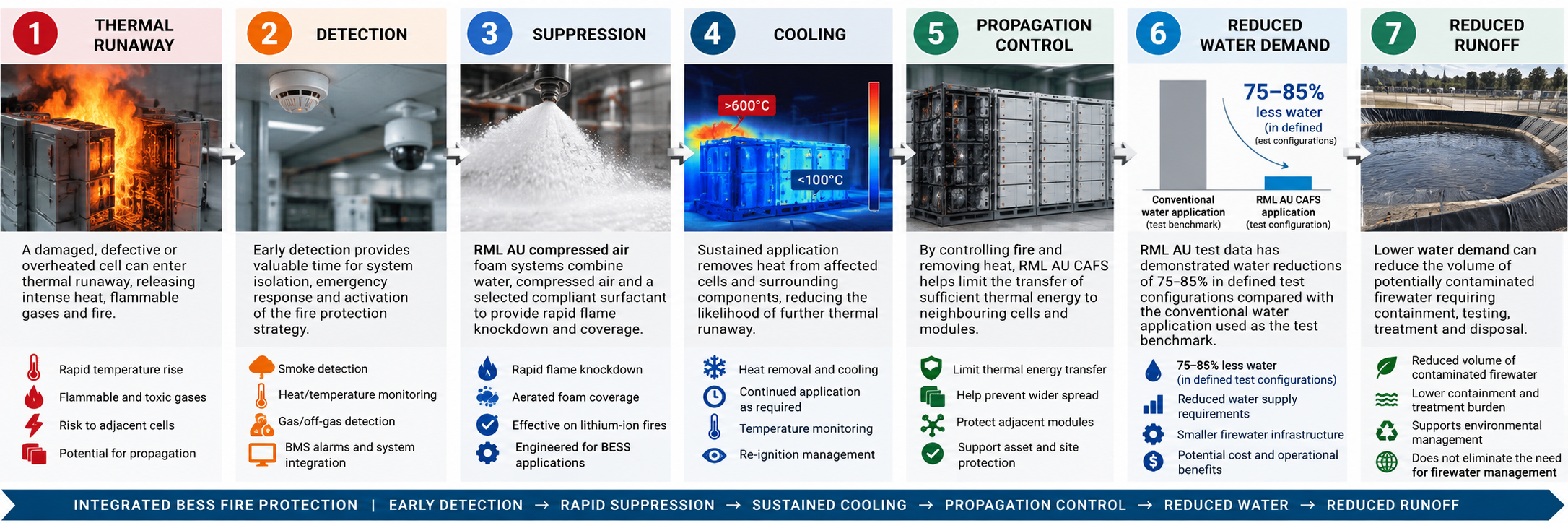
A damaged, defective or overheated cell can enter thermal runaway—a self-heating reaction capable of generating intense heat, flammable gases and fire. Heat released from the affected cell can then expose neighbouring cells and modules to sufficient thermal energy to initiate further failures.
For BESS fire protection, extinguishing visible flame is therefore only part of the challenge.
The broader objective is to control flaming combustion, remove heat, limit thermal energy transfer to adjacent cells and modules, and reduce the likelihood or extent of fire propagation.
Limiting Thermal-Runaway Propagation
RML AU CAFS is designed to rapidly suppress flaming combustion and provide sustained cooling to the affected area.
In lithium-ion applications, the objective is to remove heat from affected cells and reduce the transfer of sufficient thermal energy to neighbouring cells and modules, helping limit thermal-runaway propagation.
This distinction is important. Fire suppression cannot be assumed to prevent the initiating cell from entering thermal runaway. The fire protection strategy must instead consider how rapidly the event can be detected, how effectively fire and heat can be controlled, and how propagation beyond the initiating failure can be limited.
Early Detection and Intervention
Effective BESS fire protection begins before suppression is activated.
Depending on the BESS design and fire safety strategy, detection may incorporate battery-management-system alarms, temperature monitoring, smoke detection, gas or off-gas detection and other early-warning technologies.
Early identification of an abnormal condition can provide valuable time for system isolation, emergency response and activation of the designed fire protection strategy.
Detection and suppression should therefore be considered as complementary elements of an integrated BESS fire safety system.
CAFS Fire Suppression
RML AU compressed air foam systems combine water, compressed air and a selected compliant surfactant to produce an aerated suppression medium designed to provide rapid flame knockdown, coverage and sustained cooling.
For BESS applications, the system is intended to:
rapidly control flaming combustion;
cool affected surfaces and battery components;
reduce heat transfer to adjacent cells and modules;
support propagation control;
maintain cooling following initial flame knockdown; and
achieve these objectives with substantially lower water demand in defined tested configurations.
The appropriate suppression strategy must always be determined for the specific battery chemistry, cell and module arrangement, enclosure configuration, fire scenario and overall BESS fire safety design.
Cooling and Re-Ignition Management
Visible flame extinguishment does not necessarily mean that the lithium-ion battery hazard has ended.
Residual heat and continuing electrochemical reactions can create the potential for further thermal runaway or re-ignition. Effective intervention therefore requires consideration of both flame suppression and heat removal.
RML AU's approach places sustained cooling alongside rapid fire knockdown. Continued temperature monitoring and an appropriate post-fire observation strategy should form part of the overall emergency response plan.
Reducing Firefighting-Water Demand
Water is an effective and important firefighting medium for lithium-ion battery incidents, particularly because of its cooling capability.
The challenge can be the quantity required to establish and maintain effective cooling, particularly for large BESS installations or sites where water supply and containment capacity are constrained.
RML AU/EZCAFS test data has demonstrated water reductions of approximately 85% under defined test configurations, compared with the conventional water application used as the test benchmark.
These results should not be interpreted as a universal water reduction applicable to every BESS installation. Actual water demand depends on battery chemistry, capacity, configuration, fire scenario, application method, system design and the required duration of suppression and cooling.
The objective is not to remove water from the fire protection strategy—it is to use water more effectively.
Firewater Runoff and Environmental Management
Firefighting-water demand has consequences beyond water supply.
Water applied during a BESS incident may become contaminated by combustion products and materials released from the battery system. The resulting firewater may require containment, testing, treatment and appropriate disposal.
Reducing the volume of water required for effective suppression and cooling can therefore also reduce the volume of potentially contaminated firewater requiring management.
This does not eliminate the need for firewater containment or environmental planning. Rather, lower water demand can reduce the hydraulic and containment burden that must be considered as part of the project's overall fire and environmental protection strategy.
Testing and Technical Evidence
RML AU's BESS proposition is based on test evidence rather than suppression-agent claims alone.
RML AU/EZCAFS testing has demonstrated rapid flame suppression, substantial cooling and propagation control under defined lithium-ion battery test conditions.
Technical assessment of a CAFS solution should consider the actual test configuration, including:
battery chemistry and capacity;
state of charge;
cell, module and pack arrangement;
fire initiation and pre-burn conditions;
suppression application method;
water and foam flow rates;
application duration;
temperature response;
propagation observations;
total water consumption; and
post-suppression monitoring and re-ignition observations.
RML AU can provide relevant test information and technical documentation to support project-specific engineering assessment.
Standards, Testing and Australian Fire-Safety Requirements
BESS fire protection in Australia requires consideration of the applicable regulatory requirements, Australian Standards, fire authority guidance, battery manufacturer's requirements and project-specific fire engineering strategy.
Depending on the installation, relevant documents and test methods may include Australian battery installation and product safety requirements, fire authority guidance, NFPA 855 and large-scale fire testing such as UL 9540A or equivalent methodologies.
Importantly, compliance with a battery installation or product standard should not be confused with demonstrating the effectiveness of a particular fire suppression strategy.
For large-scale BESS, project-specific fire testing and supporting technical evidence can be important in demonstrating separation, propagation behaviour and the effectiveness of proposed fire protection measures.
RML AU supports an evidence-based approach in which the suppression system is considered as one component of the complete BESS fire safety strategy.
A Different Approach to BESS Fire Protection
Australia's deployment of large-scale battery storage is accelerating as increasing renewable generation creates greater demand for storage, grid stability and dispatchable capacity.
As BESS capacity grows, fire protection needs to evolve with it.
The question is no longer simply:
“Can the fire be extinguished?”
The more useful questions are:
How early can an abnormal condition be detected?
How quickly can flaming combustion be controlled?
How effectively can heat be removed?
Can thermal energy transfer and propagation be limited?
How much firefighting water is required?
How will contaminated firewater be contained and managed?
What test evidence supports the proposed solution?
These are the questions RML AU believes should form part of an engineered BESS fire protection strategy.
Discuss Your BESS Fire Protection Strategy
RML AU works with BESS developers, engineers, asset owners and fire-safety stakeholders to assess CAFS applications for lithium-ion battery fire suppression, cooling, propagation control and reduced firefighting-water demand.
Talk to RML AU about your BESS project.
Download the RML AU BESS Fire Suppression Technical Information.