Wind Turbine Fire Suppression Systems Australia
Wind turbines present a distinctive fire-protection challenge.
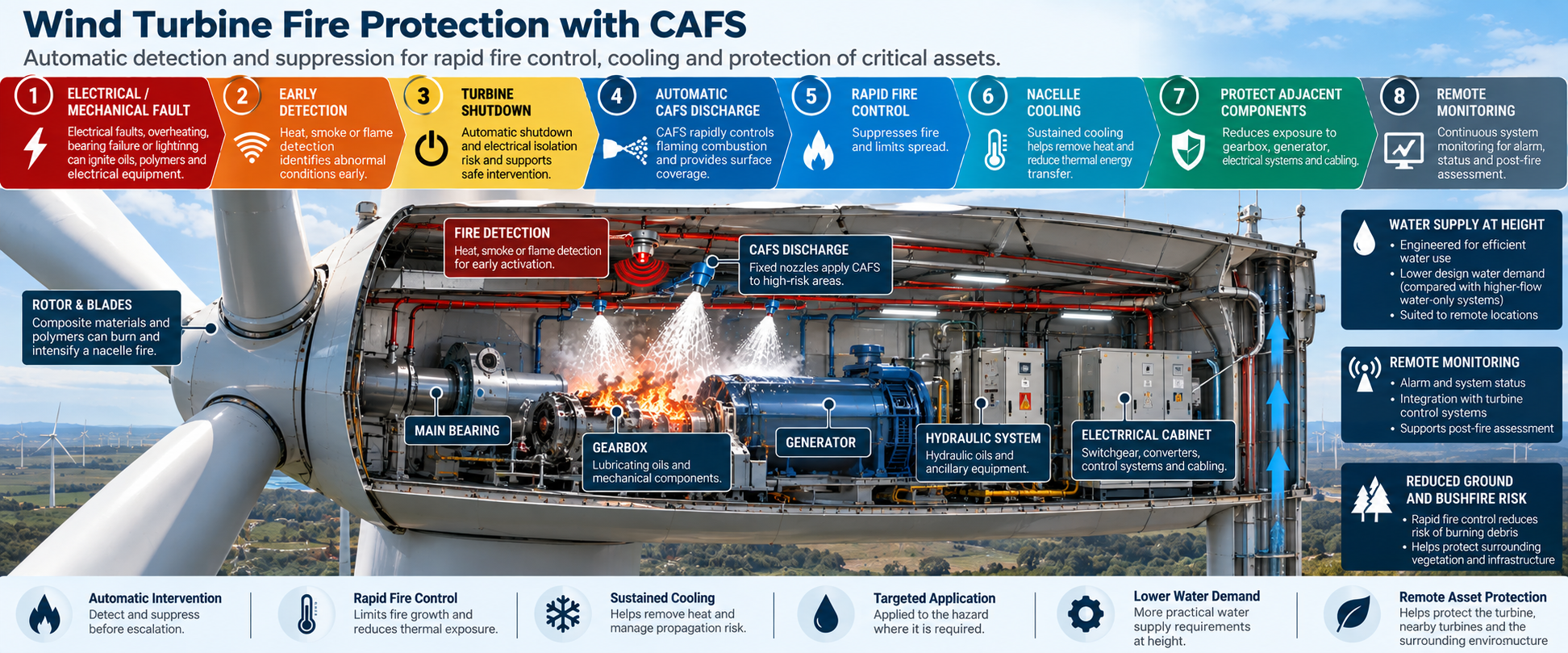
Electrical equipment, gearbox and hydraulic oils, lubricants, polymers, insulation, filters and composite materials are concentrated within a nacelle located high above ground, often in remote areas where manual firefighting access can be difficult or unsafe.
RML AU provides engineered Compressed Air Foam System (CAFS) solutions for wind-energy applications, focused on automatic early intervention, rapid fire control, sustained cooling and efficient use of firefighting water.
Understanding Wind Turbine Fire Risk
Wind turbine fires can originate from a range of mechanical and electrical failures.
Potential ignition sources include:
electrical faults;
overheating;
bearing or mechanical failure;
lightning;
electrical arcing; and
failure of associated equipment.
Once ignition occurs, combustible materials within the nacelle can contribute to fire development.
These may include:
gearbox and hydraulic oils;
lubricants;
polymers;
insulation materials;
filters;
cabling; and
composite materials.
The combination of ignition sources, combustible materials and restricted access means that early detection and automatic intervention can be particularly important.
Why Wind Turbine Fires Are Difficult to Fight
A wind turbine fire is not simply an elevated version of a conventional industrial fire.
Emergency response can be complicated by:
extreme height;
restricted nacelle access;
rotating and mechanical equipment;
electrical hazards;
remote turbine locations;
long emergency-response times;
limited firefighting water at height;
weather conditions; and
the risk of burning material falling to the ground.
Manual firefighting at nacelle level may expose responders to significant hazards.
For this reason, fire protection should consider how an incident can be detected and controlled before personnel are required to approach the fire.
Early Detection and Automatic Intervention
Early detection is critical where physical access is limited.
Depending on the turbine and fire-protection design, detection may incorporate:
heat detection;
smoke detection;
flame detection;
electrical or equipment alarms; and
turbine control-system information.
Early detection can support:
turbine shutdown;
electrical isolation where appropriate;
automatic suppression activation;
remote alarm transmission; and
emergency-response mobilisation.
Automatic intervention can be particularly valuable where a developing fire would otherwise continue until external emergency responders reach the site.
RML AU CAFS for Wind Turbines
Compressed Air Foam Systems combine water, a selected foam concentrate and compressed air to produce an aerated suppression medium.
For suitable wind-energy applications, CAFS can provide:
rapid flame knockdown;
surface coverage;
sustained cooling;
adhesion to vertical and irregular surfaces;
wetting of combustible materials;
vapour suppression where applicable;
protection of adjacent nacelle components; and
efficient use of available firefighting water.
The required system configuration depends on the turbine design, identified fire hazards, combustible materials, discharge arrangement and fire-protection objectives.
Explore How Compressed Air Foam Systems Work →
Nacelle Fire Suppression
The nacelle contains many of the components associated with wind-turbine fire risk.
These may include electrical equipment, generators, gearboxes, hydraulic systems, cabling and combustible materials.
A fixed CAFS system can be engineered to discharge within defined nacelle zones where rapid automatic suppression is required.
The objectives may include:
detect the incident → shut down equipment → activate suppression → rapidly control flaming combustion → cool affected components → limit wider nacelle involvement.
The design should reflect the actual equipment layout and fire hazards within the turbine rather than applying a standard discharge arrangement to every nacelle.
Class A and Class B Fire Risks
Wind turbines can contain both solid and liquid combustible materials.
Potential Class A fuels can include polymers, insulation and other solid combustible materials.
Potential Class B fuels can include hydraulic and gearbox oils and other flammable or combustible liquids.
The selected foam concentrate and system design should therefore be suitable for the identified fuel risks.
RML AU selects CAFS configurations around the actual fire scenario and required suppression performance.
Cooling and Exposure Protection
Rapid flame control is important, but heat removal and exposure protection can also influence the outcome of a nacelle fire.
Sustained cooling can help reduce thermal exposure to:
adjacent equipment;
cabling;
structural components;
lubricants and oils; and
other combustible materials.
The objective is to reduce the likelihood that a localised fire develops into wider nacelle involvement.
The strategy can be summarised as:
RAPID FIRE CONTROL → COOLING → PROTECT ADJACENT COMPONENTS → LIMIT ESCALATION
Firefighting Water at Height
Supplying large quantities of firefighting water to a nacelle can be challenging.
Water supply may need to overcome:
turbine height;
long vertical pipe runs;
pressure requirements;
limited space for system infrastructure; and
remote-site water availability.
An appropriately engineered CAFS system can reduce the design water demand compared with higher-flow water-only approaches in applicable configurations.
RML AU/EZCAFS testing has demonstrated substantial water reductions under defined test conditions.
These results should not be treated as a universal percentage applicable to every wind turbine installation.
Actual water requirements depend on:
turbine design;
fire hazard;
fuel;
system configuration;
application rate;
operating duration; and
required cooling performance.
The engineering benefit is not simply “less water”.
It is the ability to provide effective fire control with a more practical water-supply requirement at height.
Reduced Fire-Protection Infrastructure
Lower design water demand can have implications beyond water consumption itself.
Depending on the project, reduced flow can potentially reduce requirements associated with:
water storage;
pumps;
vertical pipework;
structural loading;
drainage; and
associated suppression infrastructure.
These benefits must be assessed on a project-specific basis.
Secondary Ground and Bushfire Risk
A nacelle fire may create consequences at ground level.
Burning debris or molten material falling from a turbine can potentially ignite vegetation or other combustible material beneath or surrounding the asset.
The risk can be particularly important in dry or remote environments.
Rapidly controlling the fire within the nacelle can therefore provide benefits beyond protecting the turbine itself.
The overall fire strategy should consider:
vegetation management;
site access;
emergency response;
weather conditions;
ground-level fire spread; and
potential bushfire consequences.
Environmental Considerations
A significant wind-turbine fire can result in:
burning oils and polymers;
smoke;
falling debris;
contaminated firewater; and
potential impacts to the surrounding environment.
Efficient suppression and reduced water demand can reduce the volume of firewater requiring management.
This does not eliminate the need for appropriate environmental planning.
The foam concentrate used must also be selected according to the fire risk, environmental requirements and applicable chemical regulations.
Foam Chemistry
RML AU CAFS can use selected fluorine-free foam concentrates appropriate to the identified fire hazard.
Any environmental claim should be based on the specific foam concentrate selected for the project and its supporting technical documentation.
Where PFAS/PFOS-free or other chemical-compliance claims are made, RML AU can provide the applicable product documentation for engineering and environmental review.
Fixed CAFS Systems for Wind Energy
Wind turbine protection is primarily a fixed-system application.
A system can be configured with:
fire detection;
automatic controls;
water supply;
foam concentrate;
compressed-air generation;
pipework;
discharge devices;
remote alarm output; and
integration with turbine shutdown or control systems where appropriate.
The system should be engineered around:
turbine geometry;
nacelle layout;
fire hazards;
vibration;
temperature variation;
maintenance access; and
environmental conditions.
RML AU's current wind-energy capability specifically recognises the vibration and temperature changes that can occur inside turbine nacelles.
Retrofit and New-Build Applications
CAFS can be considered for both:
new wind turbine installations
and
existing turbine fleets.
For retrofit projects, the design must consider the available space, existing turbine systems, structural and electrical interfaces, installation access and maintenance requirements.
For new-build projects, fire suppression can be incorporated earlier into the turbine or project fire-safety strategy.
Testing and Technical Evidence
RML AU's approach is based on evidence before claims.
Technical assessment should consider the actual fire scenario and system configuration.
Relevant factors can include:
fuel type;
fire size;
detection method;
suppression application rate;
discharge arrangement;
flame-control performance;
cooling;
operating duration;
water consumption;
system pressure;
delivery height;
environmental conditions; and
post-suppression observations.
RML AU can provide relevant CAFS technical information and available test documentation to support project-specific assessment.
Standards and Engineering Requirements
Wind turbine fire protection should be developed around the requirements applicable to the specific turbine, wind project and jurisdiction.
Depending on the project, consideration may include:
turbine-manufacturer requirements;
electrical safety requirements;
Australian fire-safety requirements;
insurer requirements;
environmental requirements;
project-specific fire engineering; and
relevant international guidance where adopted by the project.
No single suppression technology or test result should replace a complete assessment of the turbine's fire risks.
Our Engineered Approach to Wind Turbine Fire Protection
For a wind turbine, the question should not simply be:
“Can the fire be extinguished?”
The project should also consider:
How quickly can the fire be detected?
Can the turbine be shut down automatically?
Can suppression operate without exposing firefighters at height?
How quickly can flaming combustion be controlled?
Can adjacent nacelle components be protected?
How much water must be delivered to nacelle level?
Can burning debris create a ground or bushfire risk?
What evidence supports the proposed suppression system?
These questions provide a stronger basis for protecting wind-energy assets.
Discuss Your Wind Energy Fire Protection Requirements
RML AU works with wind-farm owners, turbine operators, developers, engineers and fire-safety professionals to assess CAFS applications for wind-energy assets.
Detect early. Suppress automatically. Protect the nacelle. Reduce water demand. Limit escalation.
Talk to RML AU about your wind-turbine fire-protection requirements.