Underground Mining BEV Fire Suppression Systems Australia
Battery-electric vehicles are increasingly being introduced into underground mining operations as the industry moves toward electrification and reduced diesel emissions.
This transition introduces a different fire risk.
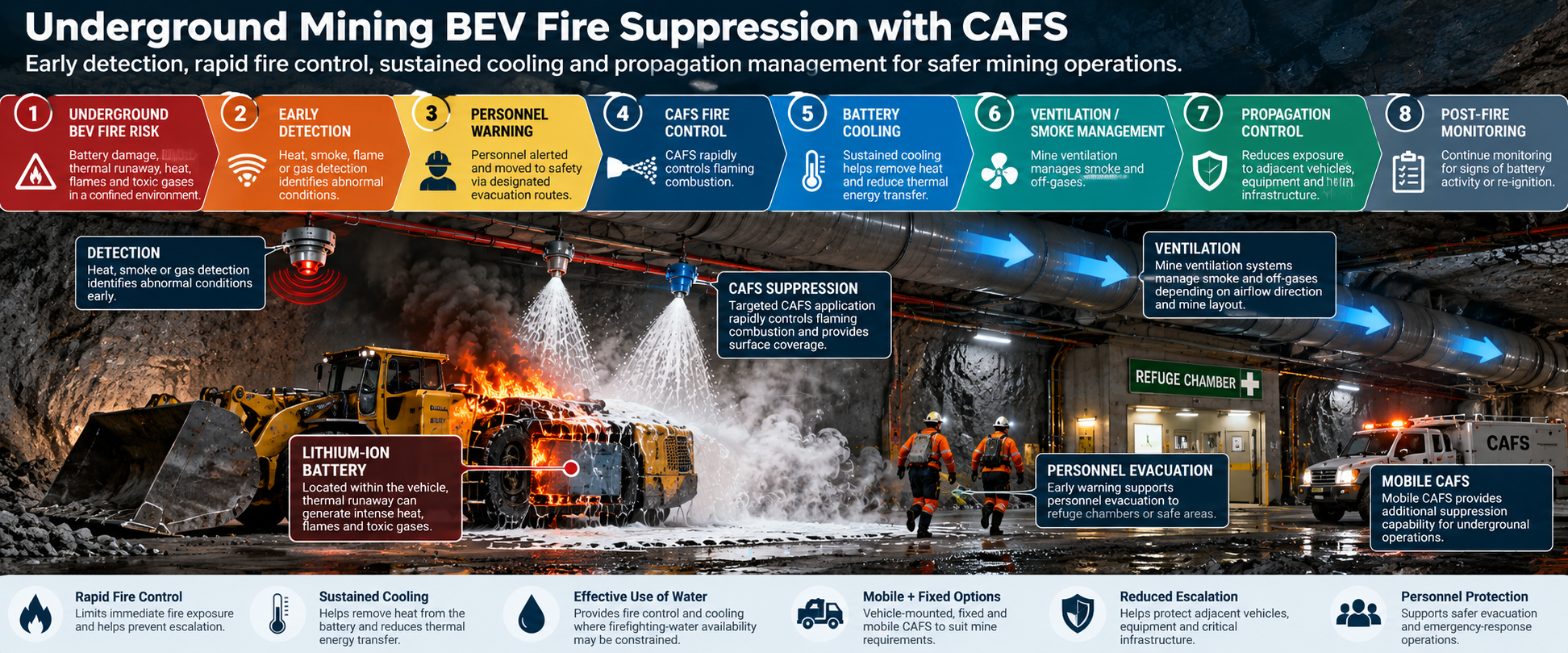
A lithium-ion battery fire underground can combine thermal runaway, intense heat, flammable and potentially hazardous gases, restricted access, ventilation constraints and long evacuation distances within an environment where firefighting water and emergency-response resources may be limited.
RML AU provides engineered Compressed Air Foam System (CAFS) solutions for underground mining and battery-electric vehicle fire risks, focused on early intervention, rapid fire control, sustained cooling, propagation management and efficient use of available firefighting water.
Why a Battery Fire Underground Is Different
An electric vehicle fire at the surface and a battery-electric vehicle fire underground present very different emergency-response conditions.
Underground incidents may involve:
confined or restricted environments;
limited access to the affected vehicle;
long travel distances;
restricted evacuation routes;
ventilation-dependent smoke movement;
heat and potentially hazardous gases;
nearby personnel;
adjacent vehicles and equipment;
charging infrastructure;
limited firefighting-water availability; and
delayed external emergency-service access.
The fire strategy therefore needs to consider the vehicle, battery, mine environment and emergency response as one integrated risk.
Lithium-Ion Battery Thermal Runaway
Battery-electric mining vehicles use high-energy lithium-ion battery systems.
If a cell is damaged, overheated or experiences an internal failure, it may enter thermal runaway.
Thermal runaway can generate:
intense heat;
flammable gases;
smoke;
fire; and
sufficient thermal energy to expose neighbouring cells and modules.
Fire suppression cannot be assumed to prevent an initiating cell from entering thermal runaway.
The suppression objective is to:
control flaming combustion → remove heat → reduce thermal energy transfer → limit escalation and propagation.
Smoke, Gas and Ventilation
In an underground mine, smoke and fire gases cannot simply disperse into the open atmosphere.
Their movement is influenced by the mine ventilation system, airway configuration, fire location and operating conditions.
A battery fire can therefore affect areas beyond the immediate location of the vehicle.
The emergency strategy needs to consider:
smoke movement;
potentially hazardous gases;
visibility;
personnel exposure;
ventilation direction;
refuge arrangements;
evacuation routes; and
firefighting access.
Suppression should be coordinated with the mine's ventilation and emergency-response strategy rather than considered in isolation.
Early Detection and Intervention
Early intervention becomes particularly important underground.
The earlier an abnormal battery or vehicle condition is identified, the greater the opportunity to:
stop the vehicle;
isolate electrical systems where appropriate;
move personnel away from the hazard;
initiate emergency procedures;
activate suppression;
establish cooling; and
control the incident before significant escalation.
Depending on the vehicle and application, detection may include temperature, smoke, flame, gas or battery-management-system information.
The appropriate strategy should be determined around the specific vehicle and mine operating environment.
RML AU CAFS for Underground Mining
Compressed Air Foam Systems combine water, a selected foam concentrate and compressed air to produce an aerated suppression medium.
For appropriate underground mining applications, CAFS can support:
rapid control of flaming combustion;
sustained cooling;
effective surface coverage;
cooling of the vehicle and battery area;
reduced thermal exposure;
protection of adjacent equipment;
propagation management; and
efficient use of available firefighting water.
CAFS does not eliminate the underlying electrochemical process occurring within a cell already undergoing thermal runaway.
Its role is to control fire, remove heat and reduce thermal exposure, helping manage escalation of the incident.
Explore How Compressed Air Foam Systems Work →
Reaching and Cooling the Battery
Battery access is a major challenge in BEV fire suppression.
Traction batteries may be enclosed within robust structures designed to protect them during normal mining operations.
This can make it difficult for an externally applied suppression medium to reach the affected cells.
Fire-protection planning should therefore consider:
battery location;
enclosure design;
suppression access;
vehicle geometry;
application direction;
cooling duration; and
responder safety.
Depending on the vehicle and risk assessment, CAFS may be delivered through fixed, vehicle-mounted, mobile or targeted application arrangements.
No single method should be assumed to be appropriate for every mining BEV.
Cooling and Propagation Management
Visible flame control is only part of managing a lithium-ion battery incident.
Residual heat and continuing battery reactions may remain after flames have been controlled.
Continued cooling can help:
remove heat from the battery area;
reduce thermal energy transfer;
protect neighbouring cells and modules;
reduce exposure to other vehicle components; and
support propagation management.
The strategy can be summarised as:
FIRE CONTROL → SUSTAINED COOLING → HEAT REMOVAL → REDUCED THERMAL ENERGY TRANSFER → PROPAGATION MANAGEMENT
Post-suppression monitoring remains important because continuing battery activity or re-ignition may occur.
Water Availability Underground
Water is an effective and important medium for fire control and battery cooling.
Underground, however, supplying large quantities of firefighting water to the point of an incident may be difficult.
Water availability can be affected by:
mine infrastructure;
location of the incident;
pipe capacity;
available pressure;
vehicle-based water supply;
access;
drainage; and
emergency-response arrangements.
RML AU/EZCAFS testing has demonstrated substantially reduced water consumption under defined fire-test configurations compared with the conventional water application used as the relevant test benchmark.
Actual mine requirements depend on the vehicle, battery, fire scenario, suppression arrangement and required cooling duration.
The objective is not to eliminate water.
It is to use the available water efficiently.
Fixed, Vehicle-Mounted and Mobile CAFS
Underground mining operations may require more than one suppression approach.
Vehicle-Mounted CAFS
Where technically appropriate, a vehicle-based system can provide suppression capability directly at the asset.
The system design needs to consider battery location, likely fire scenarios, detection, activation, discharge arrangement and the amount of suppression agent available.
Fixed CAFS
Fixed CAFS may be considered for higher-risk areas such as:
charging facilities;
workshops;
maintenance areas;
battery handling locations; and
other defined underground infrastructure.
Mobile CAFS
Mobile CAFS can support mine emergency-response teams and provide additional suppression capability for incidents beyond fixed-system coverage.
Mobile equipment may be particularly valuable where fire risks are geographically dispersed throughout an underground operation.
The appropriate combination should be determined through the mine's fire-risk and emergency-response assessment.
BEV Charging and Maintenance Areas
Fire protection should not focus solely on vehicles while they are operating.
Charging, battery handling and maintenance activities can create different fire scenarios.
The strategy should consider:
charging equipment;
electrical infrastructure;
parked BEVs;
multiple vehicles;
battery maintenance;
workshop combustibles;
ventilation;
personnel access; and
emergency isolation.
Early detection and targeted suppression can form part of the overall protection strategy for these areas.
Protecting Personnel and Critical Mine Infrastructure
The primary objective of underground fire protection is life safety.
Rapid fire control may also help reduce exposure to:
adjacent mobile equipment;
charging infrastructure;
cables;
ventilation equipment;
mine services; and
other critical infrastructure.
Preventing a localised vehicle incident from escalating into a wider underground emergency can have significant safety and operational benefits.
Firewater and Environmental Management
Firefighting water applied during a battery or vehicle fire may become contaminated by combustion products and materials released from the affected equipment.
Underground, this water may interact with mine drainage and water-management systems.
Reducing suppression-water demand can reduce the volume of potentially contaminated firewater requiring management.
It does not eliminate the requirement to assess:
drainage;
collection;
mine-water systems;
containment;
treatment; and
environmental consequences.
These issues should form part of the mine's overall fire and emergency planning.
Testing and Technical Evidence
RML AU's approach is based on evidence before claims.
RML AU/EZCAFS testing has examined defined lithium-ion battery and vehicle fire scenarios, including:
flame control;
cooling;
targeted application;
water consumption;
propagation behaviour; and
post-suppression conditions.
Testing has included a 42.7 kWh lithium-ion vehicle battery pack at 100% state of charge, providing useful technical evidence concerning CAFS application to vehicle battery fires.
The relevance of any test to an underground mining BEV must be assessed against the actual vehicle and operating conditions.
Important variables include:
battery chemistry;
battery capacity;
state of charge;
battery enclosure;
vehicle configuration;
fire initiation;
application method;
CAFS flow;
cooling duration;
total water consumption; and
post-suppression monitoring.
RML AU can provide available technical information to support engineering assessment.
Australian Mining Fire-Safety Requirements
Underground mining fire protection must be developed around the requirements applying to the particular mine, vehicle and jurisdiction.
Depending on the application, the assessment may include relevant mining legislation and regulations, Australian Standards, mine safety requirements, equipment-manufacturer requirements and site-specific risk assessments.
AS 5062:2022 — Fire prevention and protection for mobile and transportable equipment may be relevant to aspects of mobile-equipment fire protection, subject to the particular application and regulatory requirements.
Lithium-ion BEVs can also require consideration beyond conventional mobile-equipment fire scenarios because of battery thermal runaway, cooling, propagation and post-fire monitoring requirements.
The suppression system should therefore form part of a complete mine fire-safety and emergency-response strategy.
Our Engineered Approach to Underground BEV Fire Risk
For an underground battery-electric vehicle, the question should not simply be:
“Can we extinguish the vehicle fire?”
The mine should also consider:
How quickly can an abnormal battery condition be detected?
How will personnel be warned and moved to safety?
How will smoke and gases interact with mine ventilation?
Can suppression reach the battery area?
How will sustained cooling be established?
Can escalation to adjacent equipment be limited?
How much firefighting water is available at the incident location?
How will the vehicle be monitored following suppression?
What evidence supports the proposed suppression strategy?
These questions provide a stronger basis for managing the emerging fire risks associated with underground mine electrification.
Discuss Your Underground Mining Fire Protection Strategy
RML AU works with mining companies, vehicle manufacturers, engineering organisations, mine contractors and fire-safety professionals to assess CAFS applications for battery-electric vehicles and underground infrastructure.
Detect early. Control the fire. Remove heat. Protect personnel. Use water efficiently.
Talk to RML AU about your underground mining or BEV fire-protection requirements.