EV Fire Suppression for Underground Car Parks & Charging Facilities
EV Fire Suppression for Underground Car Parks & Charging Facilities
The growth of electric vehicles is changing the fire-risk profile of residential, commercial and public parking facilities across Australia.
An electric vehicle battery fire inside an underground or enclosed car park presents challenges beyond the vehicle itself. Restricted access, low ceiling heights, closely parked vehicles, smoke accumulation, potentially hazardous gases, structural exposure and limited firefighting access can combine to create a complex emergency.
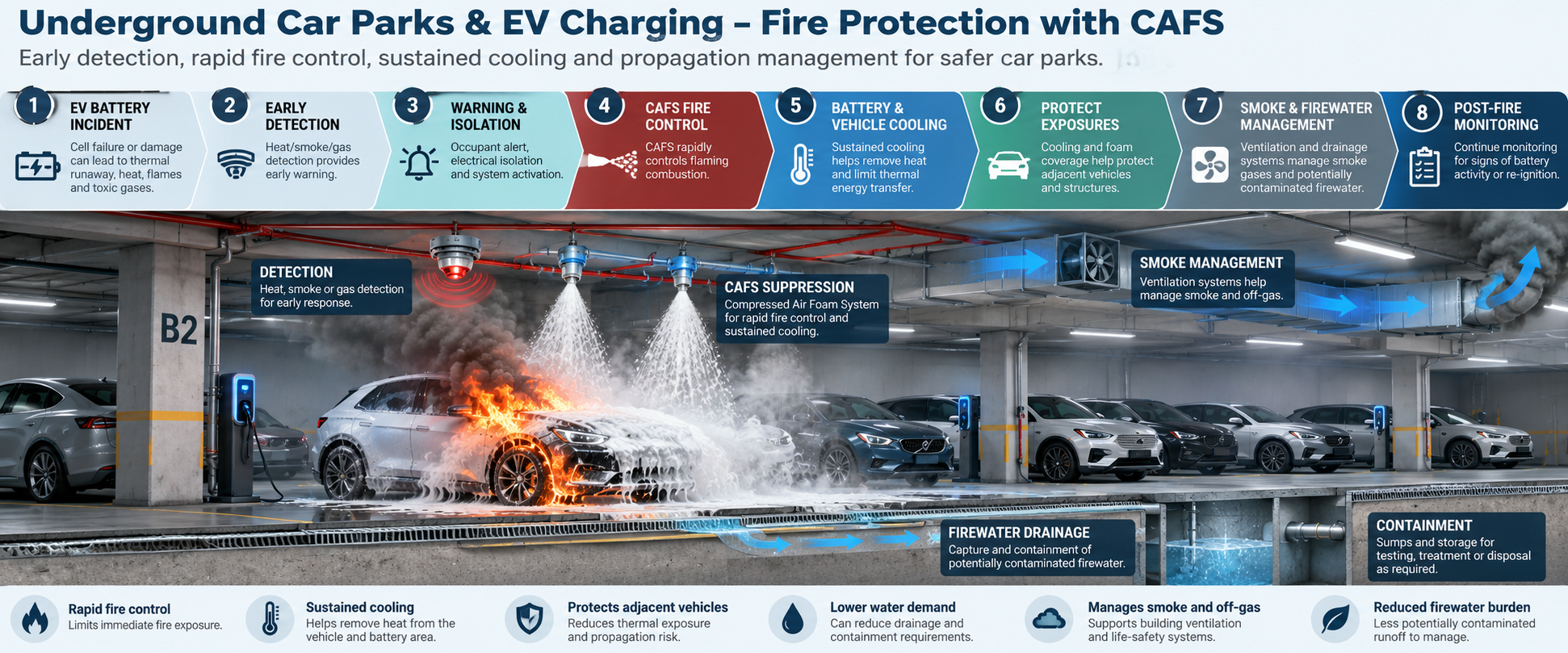
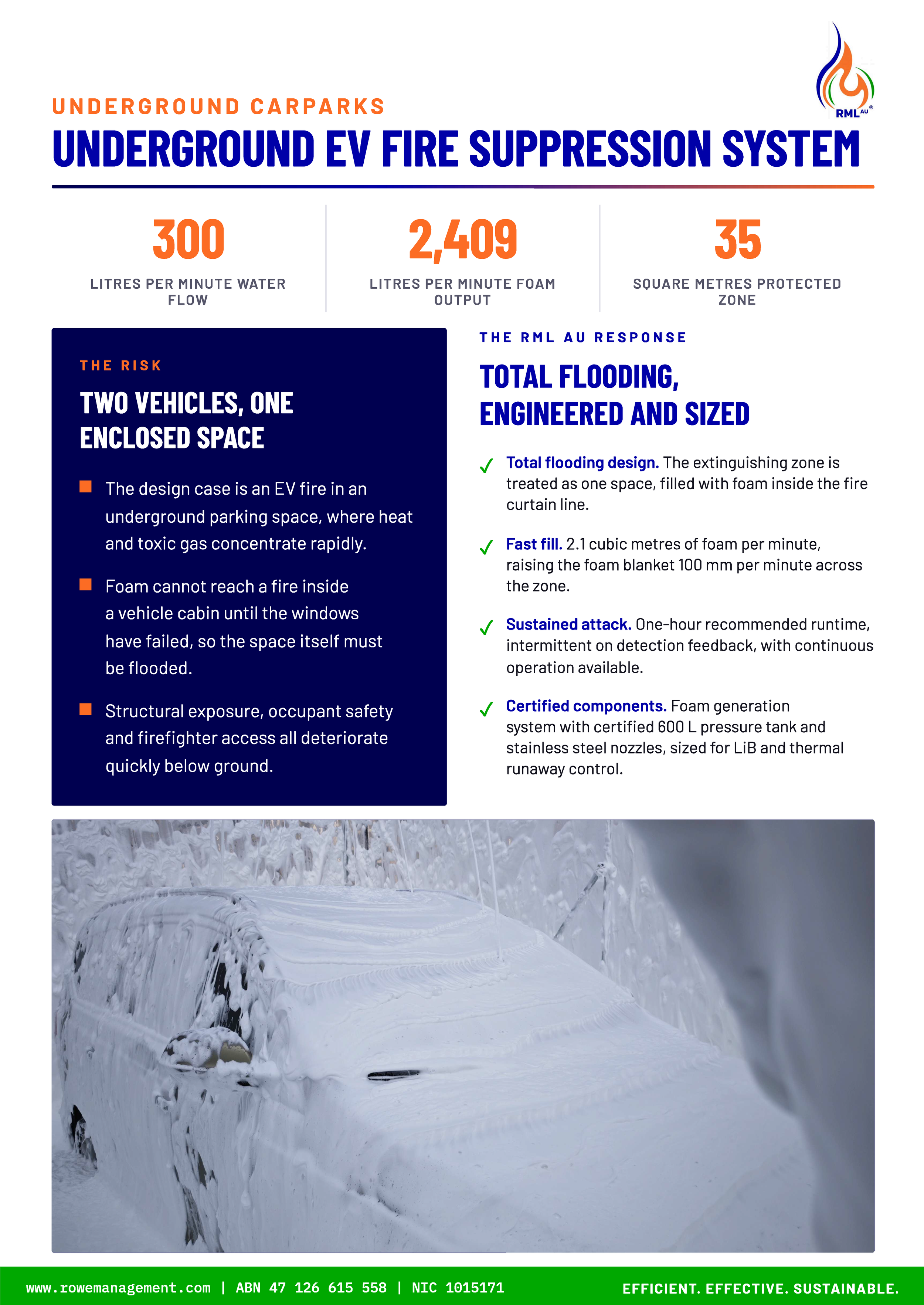
RML AU provides engineered Compressed Air Foam System (CAFS) solutions for EV and lithium-ion battery fire risks, focused on early intervention, rapid fire control, sustained cooling, propagation management and efficient use of firefighting water.
Why EV Fires in Car Parks Require Specific Consideration
An EV fire in an open environment and an EV fire several levels below a building are not the same fire-protection problem.
Inside an underground or enclosed parking structure, the fire may affect:
occupants and evacuation routes;
neighbouring vehicles;
structural elements;
electrical and charging infrastructure;
ventilation and smoke-management systems;
firefighter access;
drainage systems; and
other building services.
The fire strategy therefore needs to consider both the vehicle fire and its potential consequences for the building and its occupants.
Lithium-Ion Battery Thermal Runaway
An EV traction battery can contain hundreds or thousands of lithium-ion cells.
If a cell is damaged, overheated or experiences an internal failure, it may enter thermal runaway, generating heat, flammable gases and potentially fire.
Heat released from the affected area can expose neighbouring cells and modules, potentially contributing to further thermal runaway and propagation.
Fire suppression cannot be assumed to prevent an initiating cell from entering thermal runaway.
EV battery packs can be difficult to access directly during a fire. Suppression strategy should therefore consider vehicle and battery configuration, access to the affected area, sustained cooling and the potential for continued heat generation or propagation within the battery pack.
Smoke, Heat and Gas in Enclosed Structures
An EV battery fire can produce significant smoke and gases.
In an underground car park, those products may accumulate or travel through the structure differently from an outdoor incident.
The resulting conditions can affect:
visibility;
evacuation;
firefighter access;
tenability;
smoke-management systems;
adjoining areas; and
emergency operations.
The interaction between fire suppression, smoke control, ventilation and evacuation should therefore form part of the overall fire-engineering strategy.
Fire suppression should not be considered in isolation from the building's other life-safety systems.
Closely Parked Vehicles and Fire Spread
Vehicles in parking facilities are typically positioned close together.
A significant vehicle fire can therefore expose neighbouring vehicles to radiant and convective heat.
Where an EV battery is involved, prolonged heat release can increase the challenge.
A suppression strategy should consider not only the initiating vehicle but also the potential for:
vehicle-to-vehicle fire spread;
heating of adjacent EV battery packs;
exposure of building elements;
involvement of nearby combustible materials; and
escalation beyond the original parking space.
Rapid fire control and sustained cooling can help reduce these exposures.
Early Detection and Intervention
Time is critical when managing a developing fire in an enclosed parking environment.
Early detection can provide additional time for:
occupant warning and evacuation;
electrical or charging-system isolation;
activation of suppression systems;
smoke-management response;
emergency-service notification; and
intervention before the incident develops further.
The appropriate detection strategy depends on the building, parking arrangement, charging infrastructure and fire-engineering design.
Where practical, suppression should complement—not replace—the building's detection, alarm, smoke-control, sprinkler and emergency-response systems.
RML AU CAFS Fire Suppression
Compressed Air Foam Systems combine water, a selected foam concentrate and compressed air to produce an aerated suppression medium.
For appropriate EV and car-park applications, CAFS can support:
rapid control of flaming combustion;
sustained cooling;
effective surface coverage;
reduced thermal exposure;
cooling of the vehicle and battery area;
protection of adjacent exposures;
propagation management; and
efficient use of firefighting water.
The objective is not simply to make the visible flames disappear.
The strategy is:
FIRE CONTROL → COOLING → HEAT REMOVAL → REDUCED THERMAL EXPOSURE → PROPAGATION MANAGEMENT
Explore How Compressed Air Foam Systems Work →
Reaching the EV Battery
One of the fundamental challenges in an EV fire is reaching the traction battery.
Battery packs are commonly installed beneath the vehicle and protected within structural enclosures.
Thermal runaway is a fire fighters freind.
In a car park, access may be further complicated by:
vehicles parked on either side;
walls or columns;
wheel stops and barriers;
low clearances;
restricted hose access; and
hazardous conditions surrounding the vehicle.
The fire-protection design should therefore consider how suppression and cooling can be delivered to the vehicle and battery area.
Depending on the application, this may include fixed, targeted, under-vehicle or emergency-response application methods.
No single application method should be assumed to be appropriate for every vehicle or building.
Cooling and Propagation Management
Rapid flame control is important, but it is only one part of lithium-ion battery fire management.
Residual heat and continuing electrochemical reactions may remain after visible flames have been controlled.
Continued cooling can help:
remove heat from the affected area;
reduce thermal energy transfer;
protect neighbouring cells and modules;
reduce exposure to adjacent vehicles and structures; and
support propagation management.
Post-suppression monitoring remains important because re-ignition can occur.
Protecting Adjacent Vehicles and the Structure
An enclosed car park concentrates valuable assets within a relatively small area.
A fire involving one vehicle can potentially expose:
adjacent vehicles → charging equipment → electrical services → building structure → other areas of the facility.
An engineered suppression strategy should therefore consider exposure protection alongside control of the initiating fire.
CAFS can provide surface coverage and cooling to appropriate exposed surfaces while simultaneously supporting control of the primary fire.
The specific arrangement must be determined through project-specific fire engineering.
Firefighting-Water Demand
Water remains an important medium for controlling fire and removing heat from lithium-ion battery systems.
However, high firefighting-water demand can create particular challenges inside buildings.
The building may need to manage:
incoming firewater;
drainage capacity;
basement sumps;
pumps;
storage or containment;
contaminated water;
overflow pathways; and
water migration to other parts of the building.
RML AU/EZCAFS testing has demonstrated reduced water consumption under defined lithium-ion battery and EV test configurations compared with the conventional water application used as the relevant test benchmark.
These results are test-specific.
Actual project requirements depend on the vehicle, battery, fire scenario, application method, system design and building fire-engineering requirements.
The objective is not to eliminate water.
It is to use water more effectively.
Firewater Runoff and Environmental Management
Water used during an EV fire may become contaminated by combustion products and materials released from the vehicle and battery.
In an underground car park, this water can enter:
floor drains;
sumps;
stormwater systems;
sewer systems; or
other parts of the building.
Firewater management therefore deserves consideration during design rather than only after an incident occurs.
Reducing suppression-water demand can reduce the volume of potentially contaminated runoff requiring collection, containment, testing, treatment or disposal.
It does not eliminate the need for appropriate firewater and environmental planning.
EV Charging Infrastructure
The transition to electric vehicles is also increasing the amount of electrical infrastructure installed within car parks.
Depending on the facility, this may include:
EV chargers;
distribution boards;
electrical cabling;
load-management equipment;
transformers; and
battery or energy-storage equipment.
Fire protection should therefore consider the interaction between the vehicle, charging equipment and wider electrical installation.
Isolation, detection, suppression and emergency procedures should be coordinated as part of the overall fire-safety strategy.
Integration with Building Fire Systems
CAFS should not be treated as a standalone substitute for the building's required fire-safety systems.
A project may need to consider integration with:
automatic fire detection;
occupant warning;
sprinkler systems;
smoke-control systems;
mechanical ventilation;
emergency power arrangements;
electrical isolation;
fire brigade systems;
emergency response procedures; and
building management systems.
The objective is an integrated response in which each system performs its intended function.
Testing and Technical Evidence
RML AU's approach is based on evidence before claims.
RML AU/EZCAFS testing has examined defined EV and lithium-ion battery fire scenarios, including fire control, cooling, application methods, water consumption and post-suppression behaviour.
EV testing has included a 42.7 kWh lithium-ion vehicle battery pack at 100% state of charge, providing technical evidence relevant to the development of CAFS strategies for vehicle battery fires.
Test results must always be considered within the conditions under which the test was performed.
Relevant variables include:
battery chemistry;
battery capacity;
state of charge;
vehicle and battery configuration;
fire initiation;
pre-burn period;
application method;
suppression flow;
application duration;
cooling performance;
total water consumption; and
post-test observation.
Explore RML AU Electric Vehicle Fire Suppression →
Fire Engineering and Australian Requirements
EV fire protection within buildings should be considered within the complete building fire-safety strategy.
The applicable requirements will depend on the building classification, construction, parking arrangement, charging infrastructure, fire systems, jurisdiction and project fire-engineering design.
The strategy may need to consider applicable Australian regulatory requirements and standards, fire authority guidance, electrical requirements, building requirements, insurer expectations and equipment-manufacturer information.
Project-specific assessment is particularly important where a proposed suppression strategy differs from conventional building fire-protection arrangements.
An Engineered Approach to EV Fire Risk
For an underground EV fire, the engineering question should extend beyond:
“How do we extinguish the vehicle?”
It should also ask:
How quickly will the incident be detected?
How will occupants be warned and evacuated?
How will firefighters access the vehicle?
How will suppression reach the battery area?
How will heat be removed?
How will adjacent vehicles and the structure be protected?
How much firefighting water will be required?
Where will contaminated firewater go?
How will suppression interact with smoke control and other building systems?
What evidence supports the proposed strategy?
These questions provide a stronger basis for managing the emerging EV risk within Australian parking facilities.
Discuss Your Car Park or EV Charging Project
RML AU works with building owners, developers, fire engineers, insurers, facility managers, electrical contractors and other stakeholders to assess fire-protection strategies for EV charging and parking facilities.
Detect early. Control the fire. Remove heat. Protect exposures. Manage the water.
Talk to RML AU about your underground car park or EV charging project.