Waste & Recycling Fire Suppression Systems Australia
Waste and recycling facilities face a growing fire challenge from lithium-ion batteries entering collection and processing streams alongside conventional combustible materials.
Batteries can be damaged, crushed, punctured or exposed to heat during collection, transport and processing, creating the potential for thermal runaway and fire in vehicles, conveyors, shredders, sorting equipment, bunkers and stockpiles.
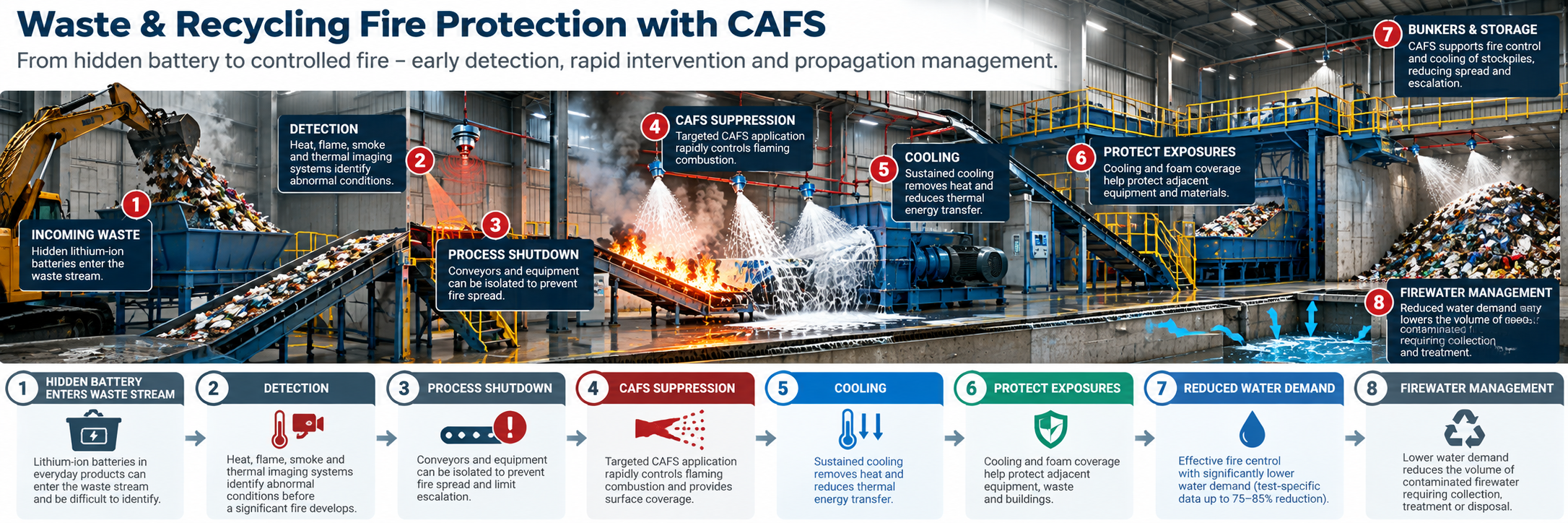
RML AU provides engineered Compressed Air Foam System (CAFS) solutions for waste and recycling fire risks, focused on early intervention, rapid fire control, sustained cooling, limiting fire spread and using firefighting water efficiently.
The Lithium-Ion Battery Problem in Waste Streams
Lithium-ion batteries are increasingly present in everyday products.
When these products enter general waste or recycling streams, batteries may be difficult to identify before they reach mechanical processing equipment.
Damage during:
compaction;
crushing;
shredding;
sorting;
handling; or
stockpiling
can initiate an internal battery failure.
A damaged or overheated lithium-ion cell can enter thermal runaway, generating intense heat, flammable gases and potentially fire.
Once established in a waste or recycling facility, the fire can involve surrounding combustible material and escalate rapidly.
Why Waste and Recycling Fires Can Escalate Quickly
A recycling facility is a dynamic industrial environment.
Combustible materials can be continuously moving through conveyors, processing lines, bunkers and storage areas.
A relatively small ignition event can therefore develop into a larger incident if it is not identified and controlled quickly.
Potential escalation pathways include:
battery failure → localised ignition → conveyor or processing equipment → surrounding waste → bunker or stockpile → wider facility involvement
The fire-protection strategy should therefore focus on both the initiating event and the potential for fire to spread beyond it.
Early Detection and Intervention
For waste and recycling facilities, time is one of the most important fire-control factors.
Detecting an abnormal condition before a fire develops significantly can create the opportunity for:
process shutdown;
conveyor isolation;
equipment isolation;
targeted suppression;
removal or separation of affected material;
emergency-service notification; and
intervention before fire spreads into larger fuel loads.
Depending on the process and facility, detection strategies may include:
heat detection;
smoke detection;
flame detection;
thermal imaging;
temperature monitoring; and
other process-specific detection systems.
Detection should be selected around the particular risk rather than assuming one technology is suitable for every part of the facility.
RML AU CAFS for Waste and Recycling
Compressed Air Foam Systems combine water, a selected foam concentrate and compressed air to produce an aerated suppression medium.
For appropriate waste and recycling applications, CAFS can support:
rapid flame knockdown;
effective surface coverage;
sustained cooling;
penetration and wetting of combustible materials;
reduced thermal exposure;
control of localised battery fires;
suppression of surrounding combustible materials;
protection of adjacent equipment; and
reduced firefighting-water demand.
The required CAFS configuration depends on the fuel, equipment, process, fire scenario and suppression objective.
Targeted Protection of High-Risk Areas
Waste and recycling facilities rarely present one uniform fire risk.
Different areas of the plant can require different detection and suppression strategies.
RML AU CAFS can be considered for targeted protection of areas such as:
Conveyors
A battery or burning item transported on a conveyor can spread fire through the processing line.
Early detection combined with process shutdown and targeted suppression can help control the incident before the burning material reaches downstream equipment or larger waste accumulations.
Shredders and Processing Equipment
Mechanical processing can damage batteries and create ignition events within high-value machinery.
Rapid intervention can reduce the potential for fire to spread from the initiating equipment into surrounding materials or other parts of the process.
Bunkers and Storage Areas
Large accumulations of combustible waste can create prolonged fires that are difficult to access and cool.
The suppression strategy should consider surface fire control, penetration, cooling, access and the potential for hidden fire within the stored material.
Battery Storage and Segregation Areas
Where identified batteries are stored separately, the fire strategy should consider battery chemistry, quantity, arrangement, propagation potential, cooling and emergency access.
Collection and Transfer Areas
Battery fires may occur before materials reach the main processing plant.
Fire protection may therefore also need to address tipping floors, transfer areas, loading zones and collection vehicles.
Thermal Runaway and Propagation
For lithium-ion battery incidents, extinguishing visible flame is not necessarily the end of the event.
A damaged cell may continue generating heat after external flames have been controlled.
Heat can also transfer to neighbouring cells or batteries.
For lithium-ion applications, RML AU's CAFS strategy focuses on:
rapid fire control → sustained cooling → heat removal → reduced thermal energy transfer → propagation management
CAFS should not be described as preventing an initiating cell from entering thermal runaway.
The objective is to control the resulting fire, remove heat and help limit escalation into surrounding batteries, equipment or combustible materials.
Controlling Fire Spread
In a waste facility, propagation can mean more than battery cell-to-cell propagation.
The more significant operational risk may be fire spread from the initiating battery into the surrounding waste stream.
A suppression strategy may therefore need to protect:
adjacent waste;
conveyor belts;
machinery;
cables;
building elements;
nearby stockpiles; and
other process equipment.
The objective is:
CONTROL THE INITIATING FIRE → COOL THE AFFECTED AREA → PROTECT EXPOSURES → LIMIT WIDER FACILITY ESCALATION
Reducing Firefighting-Water Demand
Water is an important fire-control and cooling medium.
However, large waste and recycling fires can create substantial firefighting-water demand.
High water volumes can affect:
water supply;
pumping capacity;
drainage;
bunding;
retention ponds;
contaminated firewater containment;
treatment and disposal; and
emergency operations.
RML AU/EZCAFS testing has demonstrated water reductions of approximately 75–85% under defined test configurations compared with the conventional water application used as the relevant test benchmark.
These results should not be interpreted as a universal reduction applicable to every waste or recycling fire.
Actual water requirements depend on the material involved, fire size, access, application method, required cooling and engineered suppression strategy.
The objective is not simply to use less water.
It is to achieve effective fire control and cooling while using available water efficiently.
Firewater Runoff and Environmental Management
Waste and recycling fires can produce contaminated firefighting runoff containing combustion products and materials released from the waste stream.
The resulting firewater may require:
containment;
sampling;
testing;
treatment;
transport; or
controlled disposal.
Reducing suppression-water demand can reduce the volume of potentially contaminated firewater requiring management.
This does not remove the need for appropriate site drainage, bunding, containment or environmental planning.
Rather, lower water demand can reduce the hydraulic and environmental burden created during a significant fire event.
Business Interruption and Asset Protection
The impact of a waste or recycling fire is not limited to the material that burns.
A fire can damage:
shredders;
conveyors;
sorting equipment;
control systems;
electrical infrastructure;
buildings; and
other critical plant.
Loss of one key item of processing equipment can interrupt facility operations well beyond the duration of the fire itself.
Early detection and rapid targeted suppression can therefore support both:
fire safety
and
business continuity.
The objective is to control a developing incident before it becomes a major facility fire.
Fixed and Mobile CAFS Solutions
Waste and recycling facilities may benefit from a combination of fixed and mobile suppression capability.
Fixed CAFS
Fixed systems can provide targeted protection of high-risk areas such as:
conveyors;
shredders;
process equipment;
battery handling areas;
bunkers; and
selected storage zones.
Systems may be integrated with detection, process shutdown and site emergency controls.
Mobile CAFS
Mobile CAFS can provide additional flexibility for:
stockpile fires;
vehicle incidents;
remote parts of the facility;
emergency response;
difficult-to-access fires; and
incidents outside fixed protection zones.
The combination of fixed and mobile capability should be determined around the site's fire-risk profile and emergency-response strategy.
Testing and Technical Evidence
RML AU believes suppression-system performance should be supported by relevant technical evidence rather than generalised claims.
Depending on the application, assessment may consider:
fuel or waste type;
lithium-ion battery involvement;
fire size;
fire initiation;
pre-burn conditions;
detection method;
suppression application method;
CAFS flow rate;
cooling performance;
flame-control time;
total water consumption;
exposure protection; and
post-suppression monitoring.
RML AU/EZCAFS has undertaken defined fire testing relevant to CAFS flame control, cooling and water-use performance.
Test results should always be interpreted in the context of the conditions under which they were obtained.
Standards and Facility Fire-Safety Requirements
Fire protection for waste and recycling facilities should be designed around the actual processes, materials and site risks.
Depending on the facility, relevant considerations may include:
applicable Australian Standards;
fire authority requirements;
environmental requirements;
dangerous-goods requirements;
insurer requirements;
workplace safety requirements;
waste-processing equipment requirements;
site emergency plans; and
project-specific fire engineering.
The fire-protection strategy should also consider how detection, suppression, process shutdown, drainage and emergency response interact.
CAFS should be considered as one component of the overall facility fire-safety strategy.
A Different Approach to Waste and Recycling Fire Protection
For a waste or recycling facility, the question should not simply be:
“Can we extinguish the fire?”
A more complete assessment asks:
How quickly can the initiating event be detected?
Can the process be stopped before the fire moves downstream?
How quickly can suppression reach the fire?
Can heat be removed from affected batteries or materials?
Can fire spread into surrounding waste be limited?
How much firefighting water will be required?
Where will contaminated firewater go?
How quickly can the facility return to operation?
What technical evidence supports the proposed suppression strategy?
These questions form the basis of RML AU's approach to waste and recycling fire protection.
Discuss Your Waste or Recycling Facility
RML AU works with waste operators, recycling businesses, facility owners, engineers and fire-safety professionals to assess CAFS applications for high-risk processing and storage environments.
Detect early. Intervene rapidly. Control the fire. Protect the process. Use water efficiently.
Talk to RML AU about your waste or recycling fire-protection requirements.