Transformer & Electrical Fire Suppression Systems Australia
Australia's transition to electrification is increasing the importance of resilient fire protection for transformers, substations, switchgear, power infrastructure and other high-value electrical assets.
RML AU provides engineered Compressed Air Foam System (CAFS) solutions for electrical fire risks, combining rapid flame control, sustained cooling, surface coverage and efficient use of firefighting water.
For appropriate applications, CAFS provides an alternative engineering approach to conventional high-flow water protection—particularly where water supply, drainage, containment, asset exposure and electrical safety are important design considerations.
Understanding Transformer and Electrical Fire Risk
Electrical infrastructure can present complex fire scenarios.
Transformers may contain substantial quantities of combustible insulating oil, while electrical faults, overheating, insulation failure, arcing and equipment failure can provide potential ignition sources.
Once established, a transformer or electrical equipment fire can expose adjacent assets, structures, cables and other critical infrastructure to significant heat and flame.
Effective fire protection therefore needs to consider more than flame extinguishment alone.
The strategy may need to address:
rapid fire detection;
electrical isolation;
flame control;
cooling;
vapour suppression where applicable;
exposure protection;
prevention of fire escalation;
firefighting-water availability;
drainage and containment; and
emergency-response requirements.
The Challenge with Conventional Water Protection
Water is an effective firefighting and cooling medium and remains fundamental to many transformer fire-protection strategies.
However, conventional water-spray or deluge systems can require substantial design flow rates.
High water demand can influence the size and cost of:
firewater storage tanks;
pumps;
distribution pipework;
valves and discharge systems;
site drainage;
bunding and containment;
contaminated firewater storage; and
associated civil infrastructure.
For remote, constrained or water-limited sites, supplying the required firewater can become a significant engineering consideration.
RML AU's approach is not to eliminate water.
It is to use water more efficiently.
RML AU CAFS for Electrical Infrastructure
Compressed Air Foam Systems combine water, a selected foam concentrate and compressed air to produce an aerated suppression medium.
For appropriate transformer and electrical applications, RML AU CAFS can be engineered to support:
rapid flame knockdown;
sustained cooling;
effective surface coverage;
improved wetting;
adhesion to vertical and irregular surfaces;
vapour suppression where applicable;
exposure protection; and
reduced firefighting-water demand.
System configuration must be determined according to the particular electrical hazard, fuel, equipment arrangement, required application rate, electrical clearances and overall fire engineering strategy.
Explore How Compressed Air Foam Systems Work →
Transformer Fire Protection
Transformer fire protection requires consideration of both the burning equipment and the assets surrounding it.
A fire involving insulating oil or other combustible materials can produce significant flame and radiant heat, potentially exposing adjacent transformers, structures and electrical infrastructure.
An engineered CAFS strategy can provide a combination of flame control, cooling and surface coverage intended to control the immediate fire while reducing thermal exposure to surrounding assets.
Depending on the project, CAFS may be considered for:
power transformers;
distribution transformers;
substations;
switchyards;
electrical infrastructure;
generation facilities; and
other high-risk power assets.
The appropriate system should always be based on the actual equipment, fire scenario and project fire-safety requirements.
Electrical Performance and Safety
Applying any water-based suppression medium around energised electrical equipment requires careful consideration of electrical safety.
RML AU/EZCAFS has undertaken independent electrical testing to assess the behaviour of the CAFS discharge under defined high-voltage test conditions.
Testing has demonstrated compliant electrical performance under the specific voltages, application conditions and standoff distances tested.
These results should not be interpreted as universal permission to apply CAFS to energised electrical equipment at any voltage or distance.
Project design must consider:
operating voltage;
equipment configuration;
electrical isolation strategy;
discharge pattern;
nozzle or discharge device;
application distance;
system pressure;
applicable electrical clearances;
test conditions; and
relevant engineering and safety requirements.
RML AU can provide the applicable electrical test documentation for engineering review.
Reducing Firefighting-Water Demand
One of the significant potential benefits of CAFS for electrical infrastructure is reduced design water demand.
RML AU/EZCAFS technical data includes defined configurations where CAFS application rates are substantially lower than conventional water-based benchmarks.
Where supported by the project design and applicable test evidence, lower water demand can reduce the burden placed on:
Water storage → Pumps → Pipework → Drainage → Containment
The benefit is therefore not simply a smaller quantity of water discharged at the fire.
It can potentially influence the wider fire-protection infrastructure required to deliver and manage that water.
Any comparison must be based on the actual hazard, applicable design criteria, required duration and engineered system configuration.
Firewater Runoff and Containment
Water applied during a transformer or electrical infrastructure fire may become contaminated by insulating oils, combustion products and materials released from the affected equipment.
Firewater management can therefore be an important component of the overall fire-protection strategy.
Reducing suppression-water demand can reduce the volume of potentially contaminated firewater requiring collection, containment, testing, treatment or disposal.
It does not eliminate the requirement for appropriate bunding, drainage or environmental management.
Instead, it can reduce the hydraulic and containment burden that must be accommodated by the site design.
Protecting Adjacent Assets
For critical electrical infrastructure, preventing escalation can be as important as controlling the initiating fire.
A transformer fire can expose neighbouring equipment to radiant and convective heat, creating the potential for additional damage and extended outages.
CAFS can be engineered to provide cooling and exposure protection to appropriate adjacent surfaces and equipment as part of the overall fire-protection strategy.
The objective is to:
control the initiating fire → remove heat → protect exposures → reduce escalation.
Fixed CAFS Systems
Fixed CAFS can be integrated into the fire-protection strategy for appropriate electrical infrastructure.
A system may incorporate:
fire detection;
system controls;
water supply;
foam concentrate;
compressed-air generation;
distribution pipework;
fixed discharge devices; and
manual or automatic activation.
The final arrangement should be determined by the particular hazard, electrical requirements, fire engineering strategy and applicable standards.
Testing and Technical Evidence
RML AU believes that fire-protection decisions for critical electrical infrastructure should be supported by relevant test evidence and engineering assessment.
Depending on the application, technical evaluation may include:
fire hazard and fuel;
equipment configuration;
application rate;
discharge arrangement;
flame-control performance;
cooling performance;
water consumption;
exposure protection;
electrical voltage;
standoff distance;
leakage-current performance;
system pressure; and
post-suppression conditions.
RML AU can provide relevant CAFS technical documentation and available electrical test information to support project-specific engineering assessment. EZ-CAFS - YouTube
Standards and Engineering Requirements
Transformer and electrical fire protection must be designed around the requirements applicable to the particular asset and installation.
Depending on the project, consideration may include relevant Australian Standards, electrical safety requirements, fire authority requirements, insurer requirements, asset-owner standards, equipment manufacturer requirements and project-specific fire engineering.
International standards and guidance may also be relevant where adopted as part of the project's design basis.
No single test result or suppression technology should replace a complete assessment of the fire and electrical risks.
RML AU supports an evidence-based approach in which CAFS is considered as one component of the overall asset-protection strategy.
A Different Approach to Electrical Fire Protection
For high-value electrical infrastructure, the engineering question should not simply be:
“Can we extinguish the fire?”
It should also consider:
How quickly can the fire be detected?
How rapidly can flaming combustion be controlled?
How effectively can the equipment and exposures be cooled?
Can escalation to adjacent assets be limited?
How much firefighting water is required?
What infrastructure is required to supply that water?
How will contaminated firewater be contained?
What evidence supports the proposed suppression strategy?
These are the questions RML AU believes should form part of an engineered electrical fire-protection strategy.
Discuss Your Electrical Fire Protection Requirements
RML AU works with utilities, engineers, asset owners, infrastructure developers and fire-safety professionals to assess CAFS applications for transformers, substations and other high-risk electrical infrastructure.
Protecting electrification with less water.
Talk to RML AU about your electrical or transformer fire-protection project.
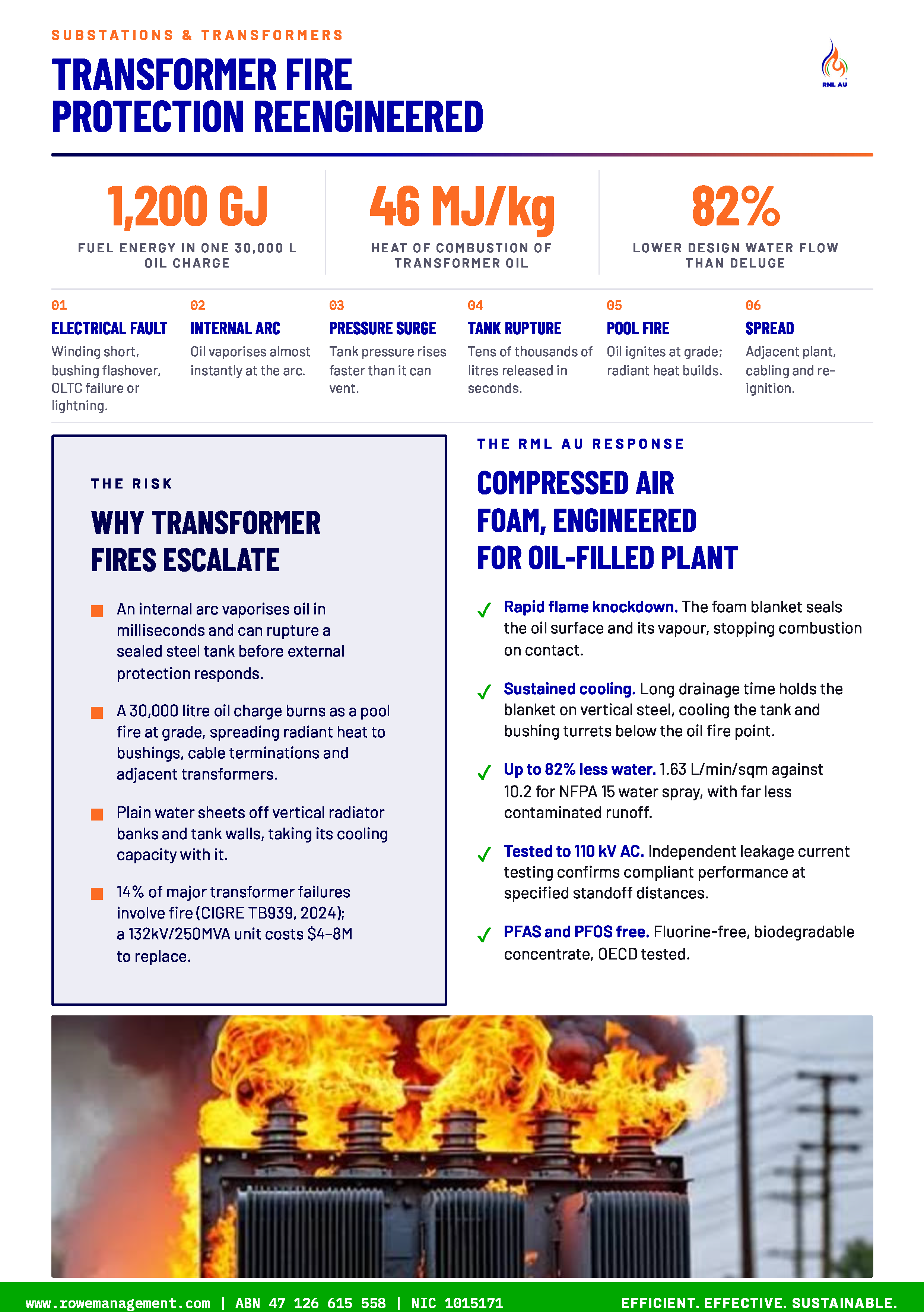
Transformer and electrical fire protection reengineered for Australia: faster control, dramatically less water, reduced runoff and smaller fire-protection infrastructure.
RML AU delivers advanced, low-water fire protection for electrified and high-risk infrastructure using CAFS to achieve rapid fire control, sustained cooling and propagation protection while reducing water demand, contaminated runoff and associated fire-protection infrastructure.
Low water content CAFS fire suppression for high-voltage electrical infrastructure, with independent leakage current testing demonstrating compliant performance up to 110 kV AC at specified standoff distances.
Protecting electrification with less water. RML AU provides engineered CAFS fire protection for transformers, substations, BESS, EV infrastructure and other high-risk electrical asset combining rapid cooling and fire control with substantially lower water demand and independently tested high-voltage electrical performance.
RML AU provides an engineered alternative to conventional transformer water deluge protection, combining rapid flame knockdown, cooling, vapour suppression and exposure protection with substantially lower water demand.
The quantified value proposition.
NFPA 15 transformer water spray: 10.2 L/min/m²
NFPA 15 ground/oil containment: 6.1 L/min/m²
Conventional low-expansion foam: 6.5 L/min/m²
EZ CAFS: 1.63 L/min/m².
Up to 82% lower design water flow than conventional deluge systems while providing cooling, flame control, vapour suppression and exposure protection.
Contact us today or double click the above image to download your copy now. Transformer and Electrical fire protection re-engineered for Australia.