Data Centre Fire Suppression Systems Australia
Data centres concentrate critical electrical infrastructure, high-value equipment and increasingly significant battery energy within facilities where fire, smoke, water and downtime can all have substantial consequences.
UPS battery systems, lithium-ion batteries, electrical equipment and supporting power infrastructure introduce fire risks that require early detection, rapid intervention and carefully engineered suppression.
RML AU provides Compressed Air Foam System (CAFS) solutions for appropriate data centre and critical-infrastructure fire risks, focused on rapid fire control, sustained cooling, limiting escalation and using firefighting water efficiently.
Fire Protection Where Continuity Matters
A fire within critical digital infrastructure can create consequences far beyond the area in which it starts.
Depending on the facility, an incident can affect:
electrical distribution;
UPS systems;
battery rooms;
backup power;
communications equipment;
cooling infrastructure;
adjoining equipment;
building services; and
continuity of operations.
The fire-protection strategy therefore needs to consider both:
controlling the fire
and
limiting the consequences of the intervention.
For data centres, rapid and targeted fire control can be particularly important where unnecessary fire growth, smoke spread or excessive water application could affect adjacent critical equipment.
Battery and UPS Fire Risk
Battery systems are fundamental to data centre resilience.
Depending on the facility, these may include lithium-ion or other battery technologies associated with:
uninterruptible power supplies;
backup power systems;
battery rooms;
modular battery systems; and
associated energy-storage infrastructure.
Where lithium-ion batteries are used, thermal runaway introduces additional considerations.
An affected cell can generate significant heat, flammable gases and potentially fire.
Heat transfer can expose neighbouring cells and modules, creating the potential for propagation.
Fire suppression cannot be assumed to prevent an initiating cell from entering thermal runaway.
The suppression strategy should instead focus on:
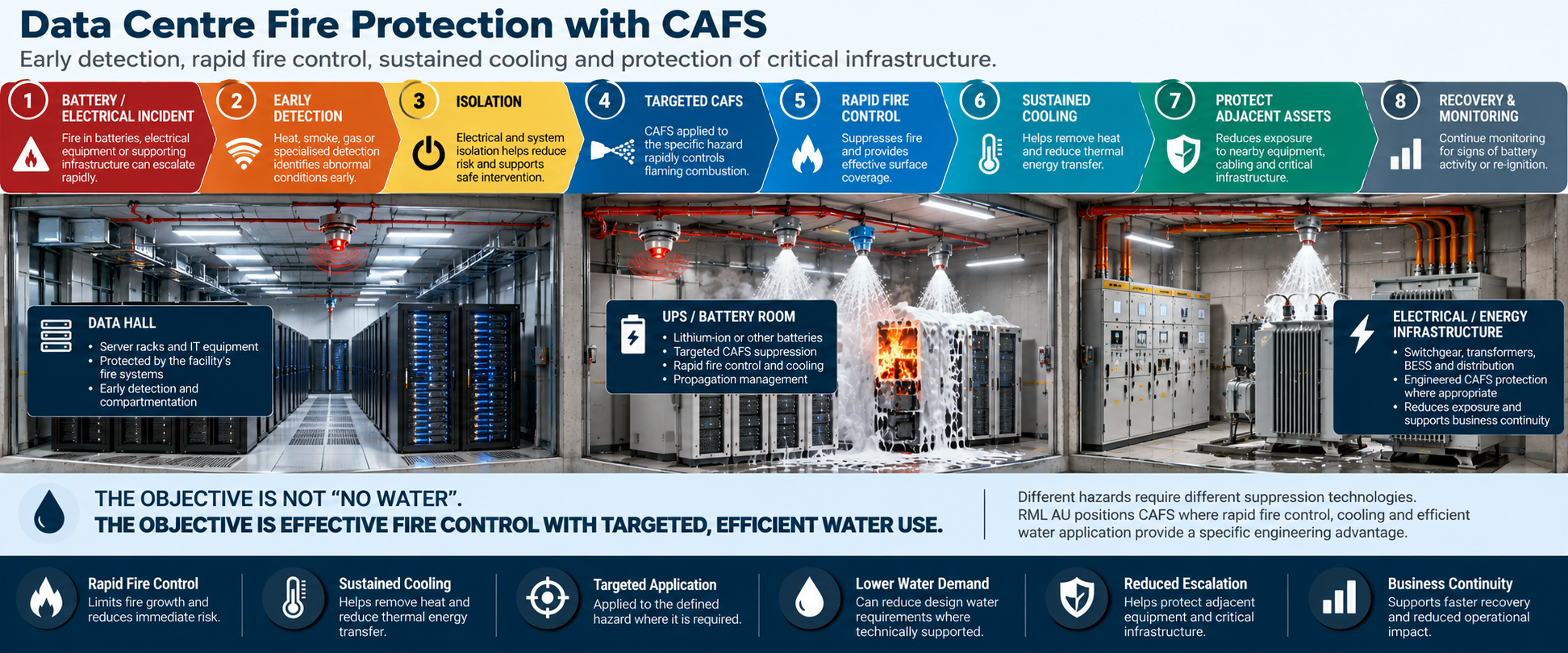
early detection → rapid fire control → sustained cooling → heat removal → reduced thermal energy transfer → propagation management.
Early Detection and Intervention
Early detection is particularly important in facilities designed around continuous operation.
Identifying an abnormal condition before a significant fire develops can provide additional time for:
alarm and investigation;
electrical isolation where appropriate;
equipment shutdown;
suppression activation;
emergency-response mobilisation; and
intervention before the incident escalates.
The appropriate detection technology depends on the particular hazard and may include combinations of smoke, heat, gas or other specialised detection systems.
Detection and suppression should be designed as coordinated elements of the overall facility fire strategy.
RML AU CAFS for Critical Infrastructure
Compressed Air Foam Systems combine water, a selected foam concentrate and compressed air to produce an aerated suppression medium.
For appropriate data centre and supporting infrastructure applications, CAFS can provide:
rapid flame control;
sustained cooling;
effective surface coverage;
reduced thermal exposure;
protection of adjacent assets;
propagation management; and
efficient use of firefighting water.
The appropriate application must be determined according to the specific hazard.
CAFS is not proposed as a universal replacement for sprinklers, gaseous suppression or other fire-protection systems used throughout data centres.
Its role should be assessed within the complete fire-engineering strategy and applied where its characteristics provide an appropriate solution to the identified fire risk.
Explore How Compressed Air Foam Systems Work →
Lithium-Ion Battery Cooling and Propagation Management
For lithium-ion battery incidents, controlling visible flames is only part of the fire problem.
Residual heat and continuing electrochemical reactions may remain after external flaming combustion has been controlled.
Continued cooling can help:
remove heat;
reduce thermal energy transfer;
protect neighbouring cells and modules;
reduce exposure to adjacent equipment; and
support propagation management.
The objective is:
CONTROL THE FIRE → REMOVE HEAT → LIMIT THERMAL EXPOSURE → MANAGE PROPAGATION
Post-suppression monitoring remains important because continuing battery activity or re-ignition may occur.
Protecting Adjacent Critical Assets
Data centres contain high-value equipment in close proximity.
A localised fire can potentially expose:
adjacent battery cabinets;
electrical switchboards;
power distribution equipment;
cabling;
cooling equipment;
structural elements; and
other critical systems.
Fire protection should therefore consider exposure protection and escalation management alongside suppression of the initiating fire.
Rapid control and sustained cooling can reduce the duration and intensity of thermal exposure to neighbouring assets.
Water Is Effective — But It Must Be Managed
Water remains one of the most effective media for absorbing heat and is particularly important when cooling lithium-ion batteries.
For data centres, however, the amount and location of water discharge also matter.
Excessive or uncontrolled water can affect equipment beyond the immediate fire area and increase:
drainage requirements;
water migration;
clean-up;
recovery time;
potentially contaminated runoff; and
collateral damage.
The objective is therefore not to remove water from the fire-protection strategy.
It is to use water effectively and apply it where it is required.
Reducing Firefighting-Water Demand
RML AU/EZCAFS testing has demonstrated water reductions of approximately 85% under defined test configurations compared with the conventional water application used as the relevant test benchmark.
These results are test-specific and should not be interpreted as a universal reduction for every data centre application.
Actual project requirements depend on:
fire hazard;
battery technology;
equipment configuration;
application method;
required cooling;
fire scenario; and
engineered system design.
Where a lower design water demand can be technically supported, it may reduce requirements associated with water storage, pumping, distribution, drainage and containment.
Targeted Protection
Different areas of a data centre can require different fire-protection technologies.
CAFS may be considered for defined high-risk applications where rapid fire control, cooling and efficient water use are required.
Potential applications may include, subject to engineering assessment:
Battery and UPS Areas
Where lithium-ion battery systems are installed, suppression may need to address both flaming combustion and continued cooling.
Battery Energy Storage Systems
Where BESS is incorporated into or associated with a data centre facility, the fire strategy should consider thermal runaway, propagation, cooling, separation, firewater and emergency response.
Electrical Infrastructure
Transformers, switchgear and other electrical infrastructure may present different fire scenarios requiring targeted protection.
Backup Power Infrastructure
Supporting energy systems and associated equipment may require fire protection appropriate to their particular fuel and electrical hazards.
External and Supporting Infrastructure
Some of the most appropriate CAFS applications may be outside the main IT white space, protecting critical supporting infrastructure before a fire can threaten data centre operations.
Integration with Existing Fire Protection
Modern data centres can employ multiple layers of fire protection.
Depending on the facility, these may include:
very-early-warning detection;
automatic fire detection;
sprinkler systems;
gaseous suppression;
pre-action systems;
smoke management;
compartmentation;
electrical isolation;
emergency power controls; and
facility emergency-response procedures.
CAFS should be integrated with this wider strategy rather than considered independently.
The engineering question is:
Where does CAFS provide an additional capability that addresses a defined risk?
This may be rapid flame control, battery cooling, exposure protection, reduced water demand or a combination of these functions.
Firewater and Environmental Management
Water applied during a battery, electrical or equipment fire may become contaminated by combustion products and materials released during the incident.
Firewater management should therefore consider:
drainage;
collection;
containment;
testing;
treatment; and
disposal where required.
Reducing suppression-water demand can reduce the volume of potentially contaminated firewater requiring management.
It does not eliminate the need for appropriate drainage, containment or environmental planning.
Testing and Technical Evidence
RML AU's approach is based on evidence before claims.
RML AU/EZCAFS has undertaken defined fire testing relevant to lithium-ion batteries, vehicle batteries and other fire risks to evaluate factors including:
flame control;
cooling;
application method;
water consumption;
propagation behaviour; and
post-suppression conditions.
The relevance of test results to a particular data centre application must be assessed against the actual hazard and system configuration.
RML AU can provide available technical documentation to support project-specific engineering assessment.
Standards and Data Centre Fire Engineering
Data centre fire protection must be developed around the requirements applicable to the particular facility, equipment and jurisdiction.
Depending on the project, consideration may include:
National Construction Code requirements;
applicable Australian Standards;
fire-engineering requirements;
electrical standards;
battery and energy-storage requirements;
fire authority requirements;
insurer requirements;
equipment-manufacturer requirements; and
international standards or guidance adopted within the project's design basis.
Where lithium-ion batteries or BESS are present, the fire strategy should also consider the available battery fire-test evidence and the particular installation configuration.
No single suppression technology should be treated as the complete data centre fire strategy.
An Engineered Approach to Data Centre Fire Protection
For critical infrastructure, the question should not simply be:
“Can we extinguish the fire?”
The engineering assessment should also ask:
How quickly can the incident be detected?
Can the affected equipment be isolated?
How quickly can flaming combustion be controlled?
If lithium-ion batteries are involved, how will heat be removed?
How will adjacent critical equipment be protected?
What quantity of firefighting water is required?
Where will that water go?
How will the suppression strategy interact with existing fire systems?
What evidence supports the proposed solution?
These questions provide a stronger basis for protecting high-value digital infrastructure.
Discuss Your Data Centre Fire Protection Strategy
RML AU works with data centre owners, developers, engineers, operators, insurers and fire-safety professionals to assess CAFS applications for batteries, electrical infrastructure and other defined high-risk areas.
Detect early. Control the fire. Remove heat. Protect critical infrastructure. Use water efficiently.
Talk to RML AU about your data centre fire-protection requirements.